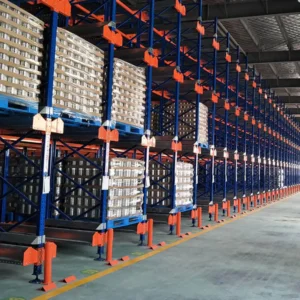
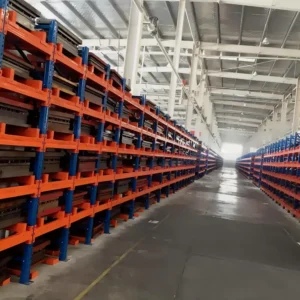
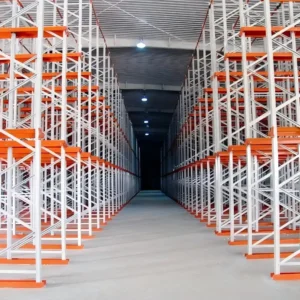
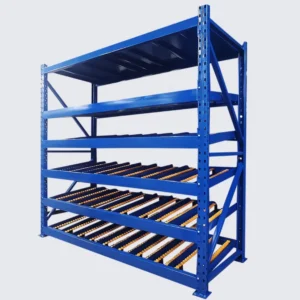
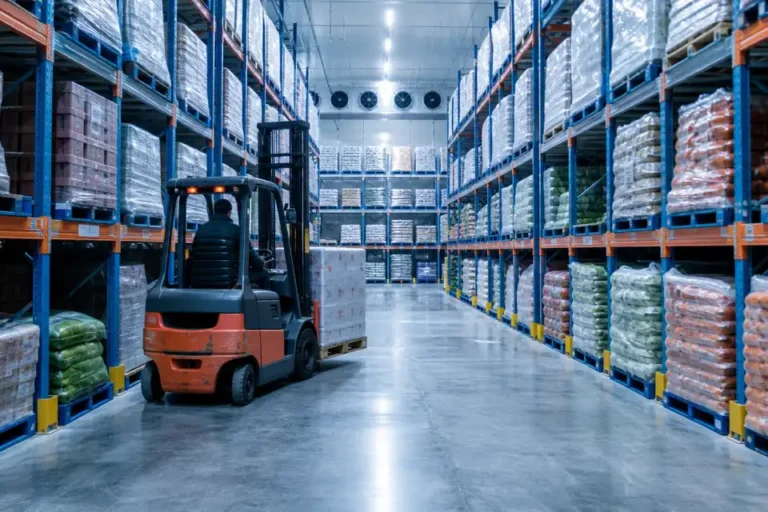
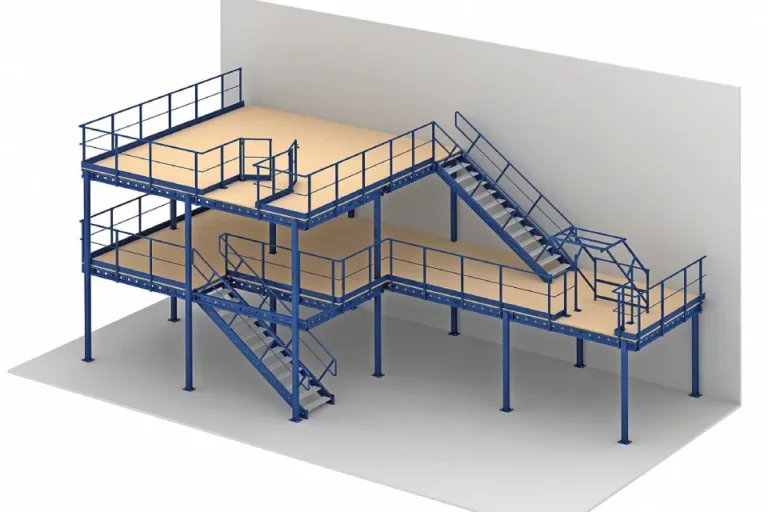
In this definitive guide, we will dissect every component of a standard Selective Pallet Racking system—the most common storage structure in the world.
We will explore the materials, the physics, the safety implications, and the subtle differences that separate a reliable system from a catastrophe waiting to happen.
Part 1: The Vertical Backbone – Upright Frames
The upright frame is the skeleton of your racking system. It is a self-supporting structure designed to transfer the immense weight of your inventory down to the concrete floor.
1.1 Upright Columns (Frames)
The main vertical columns are typically made from cold-rolled steel with a “C” or “Sigma” shaped cross-section. This shape is crucial—it provides the highest moment of inertia, resisting bending forces from forklift impacts or seismic activity.
Steel Grades: Most standard frames use Q235B steel, offering a yield strength of 235 MPa. For high-bay racking (over 8 meters) or cold storage, Q355B/D steel is mandatory. The “D” variant ensures impact toughness at -20°C, preventing brittle fractures in freezers.
Hole Patterns: The holes along the column allow for beam adjustments. Common patterns include teardrop (US standard), diamond (interlocking), and keyhole styles. The precision of these holes determines the ease of assembly and the security of the locking mechanism.
1.2 Bracing (Diagonal & Horizontal)
An upright frame is not a single piece of metal; it is a truss system. Diagonal braces (typically 1.5mm to 2.0mm thick steel) are bolted or welded between the columns.
Function: These braces prevent the frame from twisting or collapsing sideways (shear force). Without adequate bracing, a frame would buckle under lateral pressure.
Seismic Bracing: In earthquake-prone regions, additional heavy-duty bracing is required to meet RMI (Rack Manufacturers Institute) or FEM (European) standards.
1.3 Baseplates (Footplates)
This is where the rubber meets the road—or rather, where the steel meets the concrete. The baseplate is a flat steel plate welded to the bottom of the upright column.
Size Matters: A standard baseplate is 100mm x 100mm or 120mm x 120mm. For heavy-duty or seismic applications, this can increase to 150mm x 200mm to distribute the load over a wider area of the concrete floor.
Anchor Holes: The baseplate features holes for wedge anchors. These anchors are the lifeline of the rack, securing it to the floor to prevent toppling.
Part 2: The Horizontal Support – Load Beams
While uprights provide vertical support, beams provide the horizontal shelves upon which pallets rest. They bear the brunt of the weight and the impact from forklifts.
2.1 Beam Construction: Step Beams vs. Box Beams
Step Beams (Most Common): These feature a “step” or lip on the inside edge. This step supports wire decking or wooden planks. They are versatile and cost-effective.
Box Beams (Structural): These are fully enclosed rectangular tubes. They offer superior torsional rigidity and resistance to twisting. They are mandatory for very heavy loads (over 3,000 kg per pair) or in high-traffic areas.
2.2 Beam Connectors (End Fittings)
The connector is the interface between the beam and the upright. Its design dictates the safety and adjustability of the system.
Safety Lock Pins: Every beam connector must have a locking device. This is usually a spring-loaded pin or a cotter pin that prevents the beam from being accidentally dislodged by a forklift. Never operate a rack without safety pins.
Load Capacity Labels: By law and industry standard, every beam must have a visible sticker indicating the maximum load per pair of beams (e.g., “3000 KG UDL”). UDL stands for Uniformly Distributed Load.
2.3 Beam Deflection: The 1/180 Rule
One of the most critical engineering aspects of a beam is its deflection. Under load, a beam will sag. The industry standard is that the deflection must not exceed 1/180th of the span. For a 2700mm beam, this means a maximum sag of 15mm. Excessive deflection can cause pallets to get stuck or fall off.
Part 3: The Foundation – Floor & Anchoring
3.1 Concrete Floor Requirements
Racking should only be installed on concrete floors with a minimum compressive strength of 25 MPa (Megapascals). The floor thickness is equally important. For standard racking, a 150mm thick floor is the minimum. For heavy-duty systems, 200mm or more is required.
3.2 Anchor Bolts
Wedge Anchors: The most common type. They expand inside the concrete to create a secure hold.
Sleeve Anchors: Used for lighter applications.
Chemical Anchors: Used in cracked or weak concrete, where mechanical expansion might cause spalling.
Part 4: Safety & Protection Components
Over 70% of racking damage is caused by forklift impacts. Safety components are not optional; they are essential insurance.
4.1 Column Protectors (Guards)
These are heavy-duty steel or polymer barriers installed at the base of every upright.
Types: Single-post guards (protect one post), double-post guards (protect two adjacent posts), and corner guards.
Function: They absorb the kinetic energy of a forklift impact, preventing the upright column from bending or crumpling.
4.2 Row Spacers (Flue Space Maintainers)
In a back-to-back racking configuration, row spacers are rigid bars that bolt into the uprights of two facing rows.
Purpose: They maintain the flue space (usually 75mm to 150mm). This gap is a fire code requirement, allowing water from ceiling sprinklers to penetrate the rack and suppress a fire.
4.3 Guard Rails
Used at the ends of rows or around building columns, these are heavy steel rails mounted on posts. They prevent forklifts from entering pedestrian walkways or hitting structural columns.
Part 5: Decking & Support Accessories
While some pallets rest directly on beams, many require intermediate support.
5.1 Wire Decking
The most popular decking option. It consists of a grid of welded wire mesh supported by metal channels (supports).
Advantages: Allows light and air to pass through, meets fire codes (doesn’t block sprinklers), and prevents small items from falling through.
Specifications: Usually 50mm x 100mm mesh grid, with a wire gauge of 4.0mm to 5.0mm.
5.2 Wooden Decking
Often used for uneven or irregularly shaped loads. It is cheaper than wire but poses a fire hazard and can splinter.
5.3 Pallet Supports
These are “Z” shaped steel bars that hook onto the step of the beam, providing intermediate support for the decking or directly for the pallet.
Part 6: Component Selection Guide
Component
Recommended Spec (Standard)
Recommended Spec (Heavy Duty / Cold Storage)
Why it matters
Upright Steel
Q235B, 1.8mm – 2.0mm thickness
Q355D, 2.0mm – 2.5mm thickness
Prevents buckling and brittle fracture.
Beam Type
Step Beam (Box style preferred)
Box Beam (Fully enclosed)
Resists twisting under heavy loads.
Baseplate
100x100x8mm
150x200x10mm
Distributes weight to prevent floor damage.
Decking
Galvanized Wire Decking
Galvanized Wire Decking
Fire safety and load distribution.
Anchors
M12 Wedge Anchors
M16 Chemical Anchors
Keeps the rack from toppling over.
Part 7: The Assembly Process
Assembling a racking system is not a rough carpentry job; it is precision engineering.
Layout: Use a chalk line to mark the exact location of every upright.
Leveling: Use shims under the baseplates to ensure the uprights are perfectly plumb (vertical). A deviation of more than 1/1000 can compromise structural integrity.
Torquing: Anchor bolts must be tightened to a specific torque specification (e.g., 40 Nm). Under-tightening leads to loosening; over-tightening can crack the concrete.
Inspection: After assembly, a certified engineer must inspect the system. They check beam lock engagement, anchor tightness, and upright straightness.
Part 8: Maintenance & Inspection of Components
Components degrade over time due to stress and impacts. A regular inspection regime is mandatory.
8.1 Monthly Visual Checks
Look for: Bent uprights, missing safety pins, loose baseplates, and cracked welds.
Action: Immediately offload and repair any damaged section.
8.2 Repair vs. Replace
Repair: Minor dents in beams can sometimes be hammered out, but this weakens the metal.
Replace: Any upright that is bent, twisted, or has a cracked weld must be replaced. Do not attempt to weld or straighten a load-bearing upright; this ruins the heat treatment of the steel and creates a weak point.
Part 9: Integration with Other Systems
Your pallet racking components do not exist in a vacuum. They must integrate with other warehouse elements.
Fire Sprinklers: Ensure beams and decking do not obstruct the spray pattern of sprinkler heads. Maintain the required “head clearance.”
Lighting: Uprights should not block high-bay lighting. Consider the shadow cast by the frames.
Forklift Aisles: The width of your beams and the depth of your uprights determine your internal aisle width.
Part 10: Why Component Quality Defines Your Warehouse Safety
It is tempting to buy the cheapest racking components available online. However, the cost difference between a reputable manufacturer and a budget supplier is minimal compared to the cost of a collapse.
Steel Thickness: A budget upright might claim 1.8mm thickness but actually measure 1.6mm. That 11% reduction in steel can reduce load capacity by 30%.
Coating Quality: Cheap powder coating chips easily, exposing the steel to rust. Rust reduces the cross-sectional area of the steel, weakening it over time.
Tolerance: Precision manufacturing ensures that beam connectors fit snugly into upright holes. Loose fittings allow the rack to sway, increasing the risk of dislodgement.
Conclusion
Your pallet racking system is the skeletal framework of your logistics operation. Each component—from the smallest safety pin to the massive upright frame—plays a vital role in protecting your inventory, your employees, and your business continuity.
At Funyaracking, we manufacture every component to the highest international standards. We use certified steel, robotic welding, and rigorous QC checks to ensure that when you buy from us, you are buying peace of mind.